
With the recent discovery of the third interstellar comet 3I/ATLAS, let’s take a quick look at all 3 interstellar comets discovered by far! But first, what are they?
Interstellar comets are rare celestial visitors that originate beyond our solar system, offering astronomers a unique opportunity to study material formed around other stars. Unlike typical comets, which are gravitationally bound to the Sun and follow elliptical orbits, interstellar comets travel on highly hyperbolic trajectories, passing through the solar system only once before continuing their journey through interstellar space.
The first interstellar comet, Oumuamua, was only discovered in 2017. This has been made possible by increasingly advanced sky surveys and rapid follow-up observations, allowing scientists to confirm their interstellar origins in record time. Since then, only three interstellar comets have been definitively confirmed: 1I/Oumuamua, 2I/Borisov, and 3I/ATLAS. Each has revealed distinct characteristics, from unusual shapes and surface properties to unexpected chemical compositions and dust behavior.
Together, these objects act as natural probes of distant planetary systems, carrying information about environments far beyond the reach of spacecraft. Studying interstellar comets not only deepens our understanding of cometary science, but also provides valuable insight into the diversity and complexity of planetary formation across the galaxy.
Oumuamua
1I/Oumuamua is the first interstellar comet ever confirmed by astronomers, first observed on 19 October 2017 by Canadian Robert Weryk using the Pan-STARRS telescope at Haleakalā Observatory, Hawaii. Before the name of Oumuamua was given, it went by the designation 1I/2017 U1, where I stands for interstellar while 1 stands for the first interstellar object. The name Oumuamua stemmed from the Hawaiian word ʻoumuamua ‘, which roughly translates to ‘first messenger from afar’.
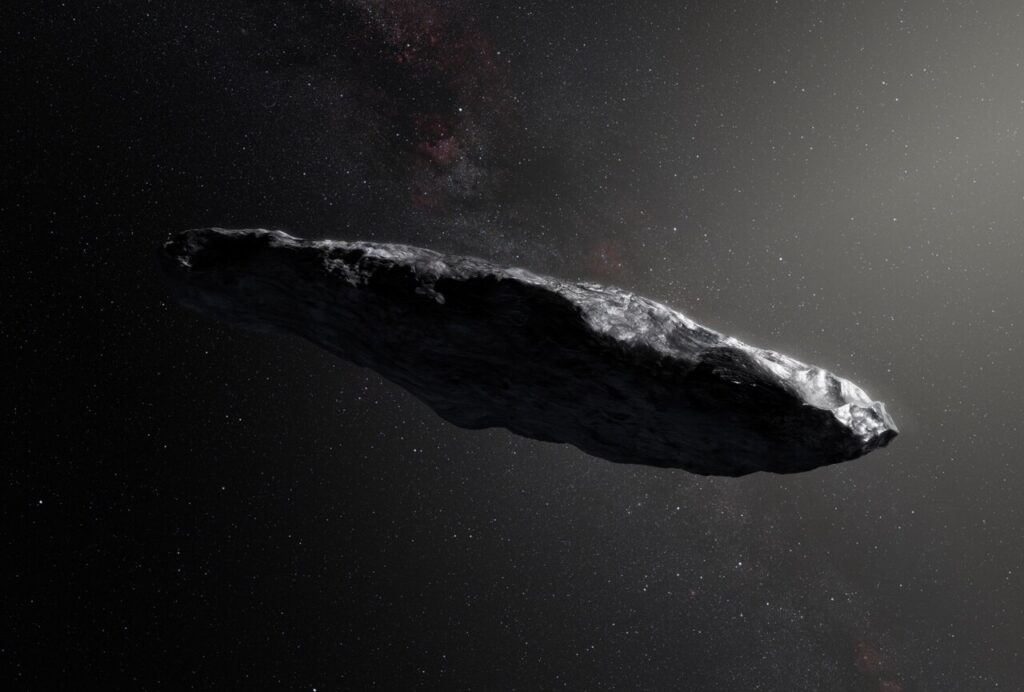
Image credit: ESO/M. Kornmesser
Oumuamua is highly elongated, slightly similar to a stretched ball of clay. At its widest, it is approximately 400m long. Its surface has a reddish hue, likely due to its long term exposure to cosmic radiation.
Fun Fact: As Oumuamua was the first of its case, the nomenclature of [nth such object]I/[given name] had to be determined by the IAU such that future objects of interstellar nature could have their naming standardised.
Borisov
2I/Borisov is the second interstellar comet to have been observed, first discovered on 29 August 2019 by Crimean amateur astronomer and telescope maker Gennadiy Borisov. It made its closest approach to the sun on 8 December 2019, at just over a distance of 2 AU. Soon after its discoveries, observations were made and at one point it was concluded that Borisov’s coma is so long that it has the length of 14 Earth’s.
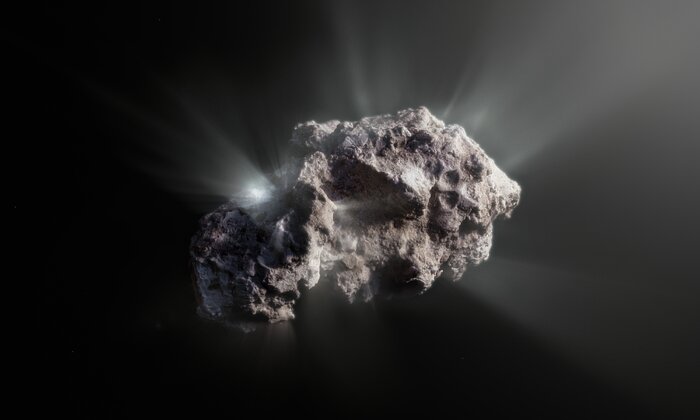
Image credit: ESO/M. Kormesser
Fun Fact: Borisov, along with the 2 other interstellar comets, are in fact not bound to the sun. For the case of Borisov, it has an orbital eccentricity of 3.36, which is an extremely hyperbolic orbit.
Atlas
3I/Atlas is the latest interstellar comet discovered by astronomers, and was first discovered by the NASA-funded ATLAS survey telescope in Rio Hurtado, Chile on July 1, 2025. It has an even more eccentric orbit than Borisov, with an eccentricity over 6. The discovery and confirmation of 3I/Atlas’ interstellar nature was done at record speeds, having its status confirmed within a day.
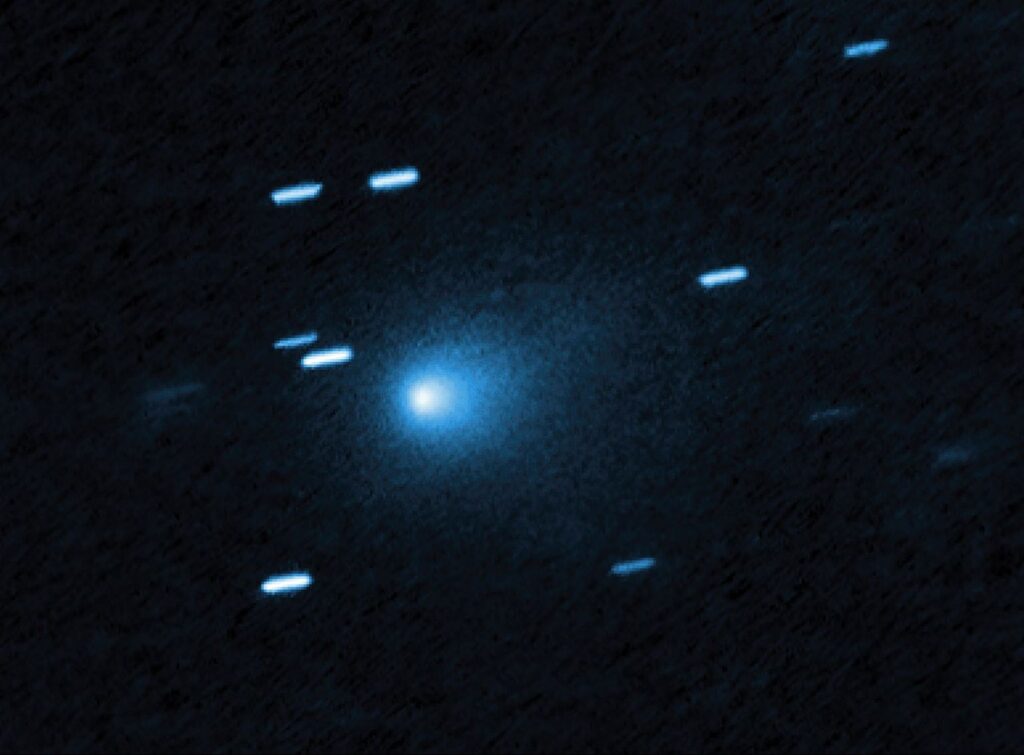
Image: NASA, ESA, David Jewitt (UCLA); Image Processing: Joseph DePasquale (STScI)
Being an interstellar object too, Atlas has many unique features that separates it from comets within the solar system. In fact, its composition is also largely different from both Oumuamua and Borisov, as it contains exceptionally high amounts of Carbon Dioxide while also being extremely depleted in carbon chain compounds.
Fun Fact: Atlas has an anti-tail, which is essentially a tail-like structure that points towards instead of away from the sun. Normally, this feature is a result of perspective, but in the case of Atlas, this is in fact the result of preferentially sublimation on the surface that’s lit by the sun, leading to a sun-facing dust plume.
Written by Fish Liu
4 January 2026
Sources
https://arxiv.org/abs/2509.07771
https://en.wikipedia.org/wiki/2I/Borisov
https://en.wikipedia.org/wiki/3I/ATLAS#Physical_characteristics
https://en.wikipedia.org/wiki/1I/%CA%BBOumuamua
https://science.nasa.gov/solar-system/comets/oumuamua/
https://science.nasa.gov/solar-system/comets/3i-atlas/3i-atlas-facts-and-faqs/
https://www.diyphotography.net/gemini-south-photographs-anti-solar-tail-of-3i-atlas/